Author: Pankaj Narsian, Vid Karmarkar, PhD
The Challenge: When VO₂max Hits a Plateau
Endurance running is increasingly recommended as a preventive health strategy due to its accessibility and its role in enhancing cardiovascular fitness, metabolic function, and overall physical health. Among adults engaging in recreational physical activity, improving exercise tolerance, economy, and aerobic capacity can be challenging without structured intervention.
To support these health-related adaptations, various training modalities have been implemented – including continuous endurance training, high-intensity interval training (HIIT), resistance exercise, and plyometric-based protocols. Each method offers distinct physiological benefits that can contribute to improved functional capacity and reduced risk of non-communicable diseases.
Among these, plyometric training has recently gained attention for its potential to enhance running performance – especially when traditional endurance approaches reach their limits. Many recreational runners notice that even as their endurance improves, race times plateau and the body feels fatigued despite increased effort.
This happens because traditional endurance work primarily improves cardiovascular capacity (VO₂max) – the maximum oxygen uptake during exercise. However, VO₂max gains eventually plateau, with most studies reporting only 5–15% improvements even under intensive training. Once this ceiling is reached, performance gains depend less on cardiovascular capacity and more on how efficiently the body uses that oxygen.
The key to breaking through this plateau lies in improving running economy (RE) – the oxygen consumed at a given pace. Enhancing RE enables runners to sustain or increase speed without additional cardiovascular strain, leading to better performance and reduced fatigue.
The Solution: Plyometric Training
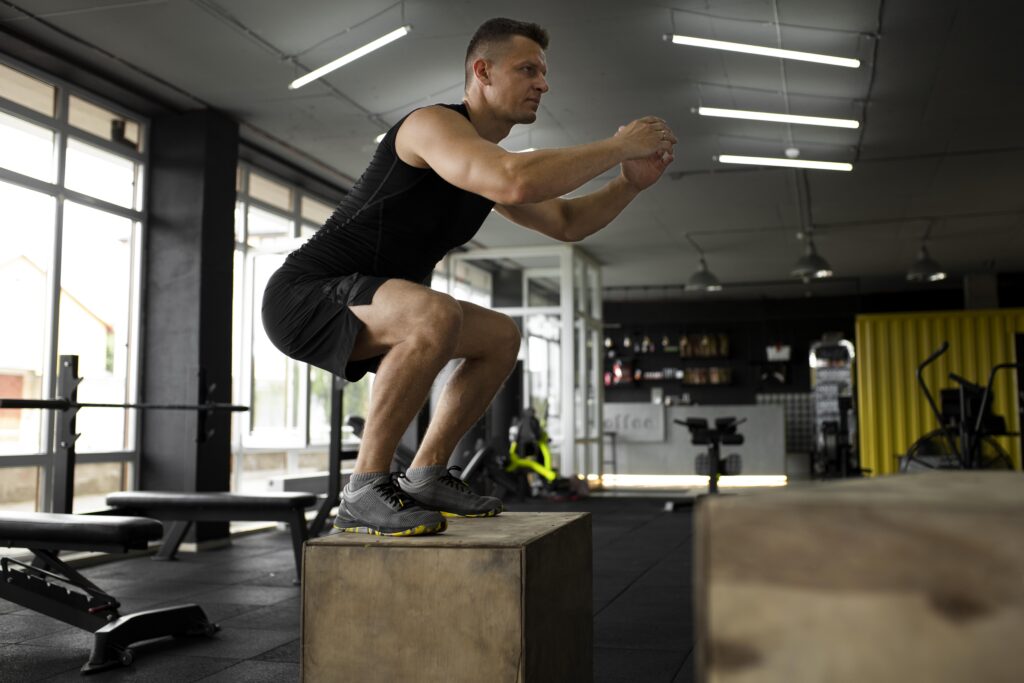
Plyometrics are explosive, jump-based exercises – like hops, bounds, and box jumps – that train muscles and tendons to rapidly stretch and contract. By targeting the stretch-shortening cycle (SSC)[1], plyometrics help the body store and recycle elastic energy efficiently with each stride.
A recent meta-analysis[2] examined the effects of plyometric training on running economy in recreational runners. The study reviewed ten randomized controlled trials involving 331 participants and found that incorporating plyometric exercises – such as hops, bounds, and jumps – significantly improved RE without altering VO₂max.
Plyometric training enhances neuromuscular efficiency by targeting the stretch-shortening cycle (SSC), which is the rapid transition from eccentric (lengthening) to concentric (shortening) muscle action. This process improves the body’s ability to store and release elastic energy during running, leading to more efficient movement patterns.
How Plyometrics Improve Running Economy
The benefits of plyometric training for running economy include:
1. Increased Musculotendinous Stiffness: Enhances elastic recoil, particularly in the Achilles tendon, improving propulsion.
2. Shorter Ground Contact Times: Leads to quicker stride turnover and reduced energy loss.
3. Improved Rate of Force Development: Allows for rapid force application, enhancing stride efficiency.
4. Better Inter-Muscular Coordination: Optimizes the interaction between muscles, stabilizing joints, and reducing energy wastage.
These adaptations result in less oxygen consumption at a given pace, translating to improved endurance and reduced fatigue during runs.
Implementing Plyometric Training
To effectively incorporate plyometric exercises into a running regimen, consider the following guidelines:
1. Establish a Strength Foundation: Prior to starting plyometric training, ensure adequate lower-body strength through exercises like squats and lunges to prevent injury.
2. Frequency and Progression: Aim for 2-3 plyometric sessions per week over a period of 6-12 weeks. Begin with low-impact exercises and gradually increase intensity and volume as strength and technique improve.
3. Timing and Recovery: Schedule plyometric workouts before endurance runs or on alternate days to allow for adequate recovery.
4. Integration with Endurance Training: Combine plyometric exercises with traditional endurance workouts to enhance both cardiovascular and neuromuscular adaptations.
By following these guidelines, runners can safely and effectively enhance their running economy, leading to improved performance and reduced fatigue.
Conclusion
While VO₂max is a critical component of endurance, improving running economy through plyometric training offers a practical and effective strategy for recreational runners seeking to enhance performance without additional cardiovascular strain. By incorporating plyometric exercises into training routines, runners can achieve more efficient movement patterns, leading to better endurance and reduced fatigue during runs. Embracing plyometric training not only improves running efficiency but also contributes to overall athleticism, making it a valuable addition to any runner’s training program.
References:
(1) Seiberl, W.; Hahn, D.; Power, G. A.; Fletcher, J. R.; Siebert, T. Editorial: The Stretch-Shortening Cycle of Active Muscle and Muscle-Tendon Complex: What, Why and How It Increases Muscle Performance? Front. Physiol. 2021, 12, 693141. https://doi.org/10.3389/fphys.2021.693141.
(2) Deviatika, F. E.; Rayhan, A. Effects of Plyometric-Based Training on Cardiorespiratory Fitness, Running Economy, and Functional Performance in Recreational Runners: A Systematic Review and Meta-Analysis. J. Med. Sci. Sports Health 2025, 1 (2), 59–70. https://doi.org/10.21831/jomassh.v1i2.1200.
